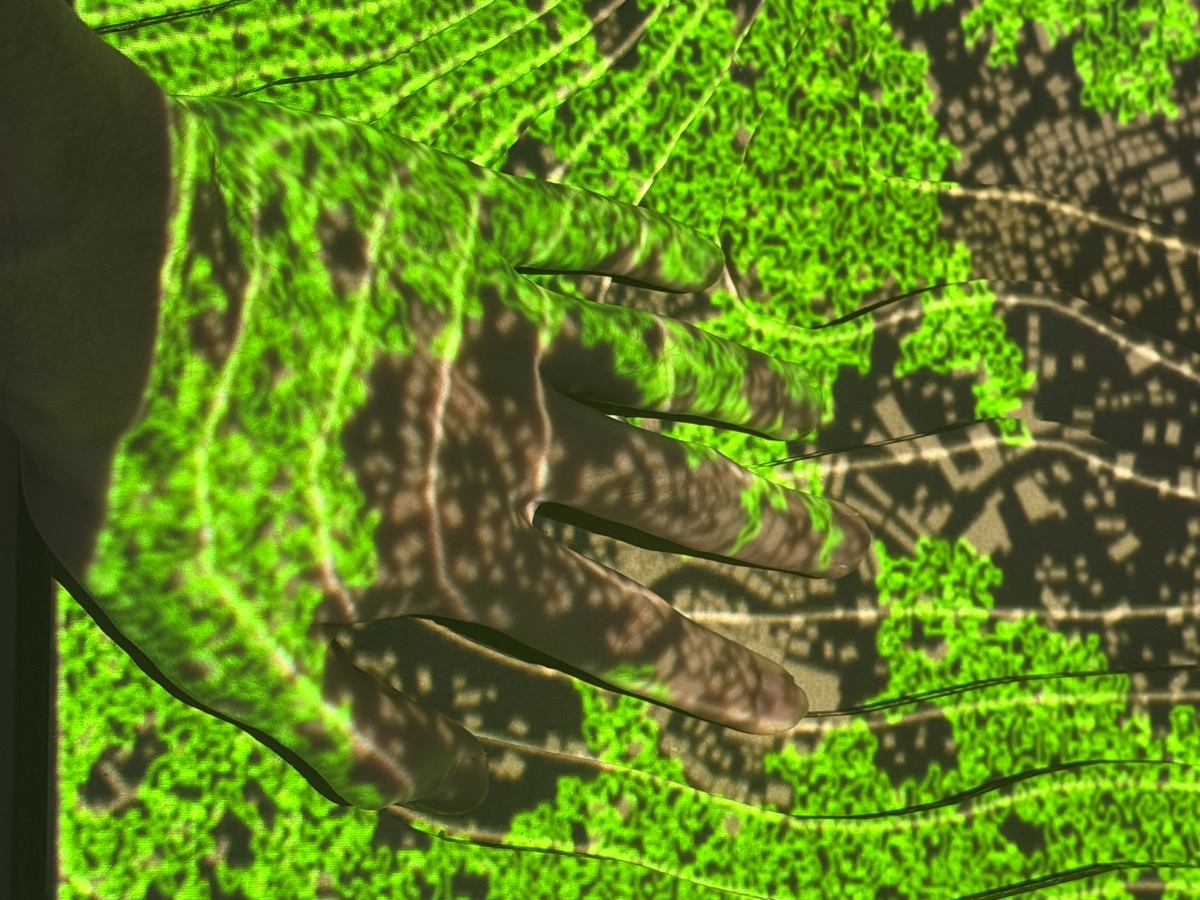
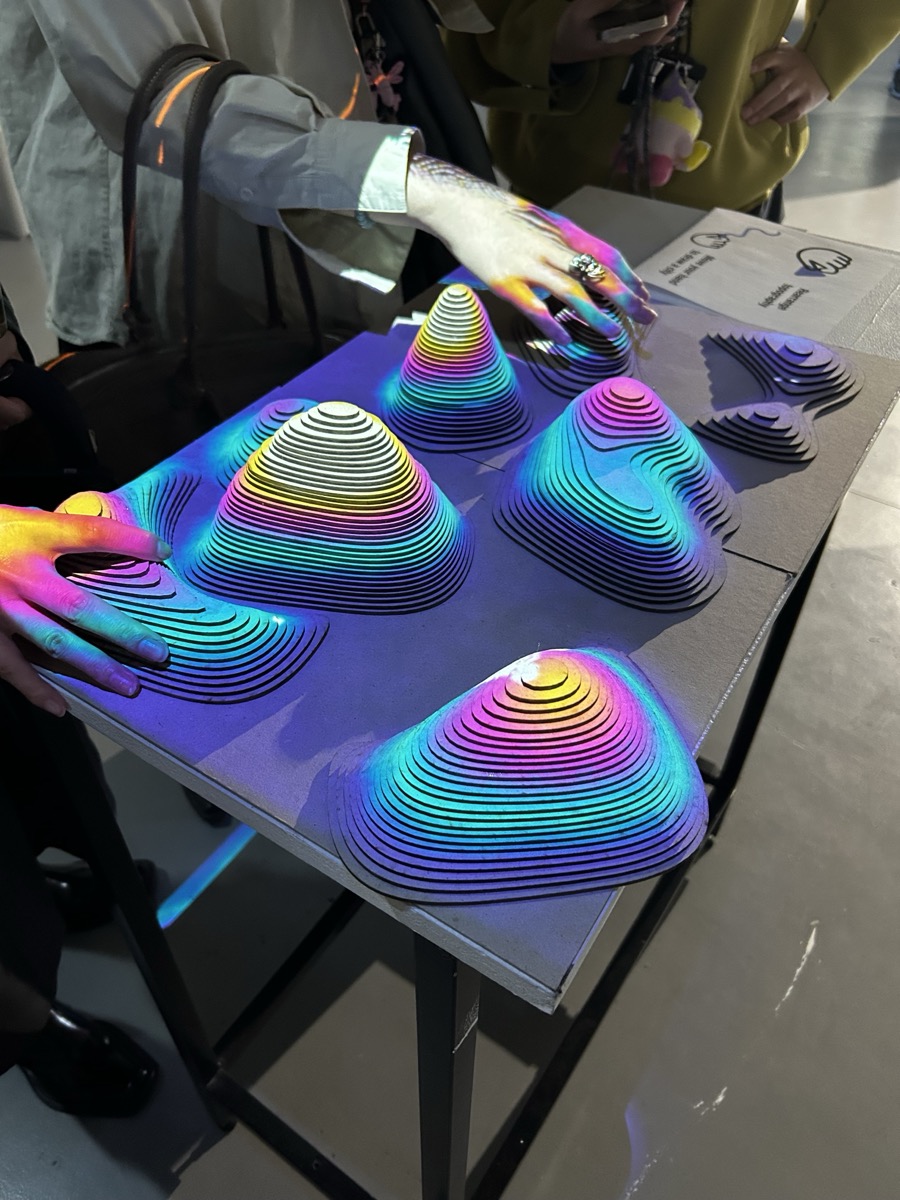
Cities grow the way organisms do — branching, clustering, pushing up against water and topography the same way roots or river systems do. For Sprint 2 of Responsive Environments, my team (with Elif and Nemo) took that parallel literally: a laser-cut cardboard topography model of Rocinha, in Rio de Janeiro, with a projector mapped onto its surface. Draw a line on a nearby surface, and it's picked up live and generated as a growing 3D form projected onto the terrain below.
The brief was "Emergence," and we split the piece into three threads. Nemo worked on particle-based urban generation, Elif modeled and laser-cut the physical topography and handled projection mapping, and I owned the interaction layer — live edge detection in TouchDesigner, turning a physical mark into a generated 3D form in real time.
SHOULD CITIES FOLLOW A GRID?
The brief for the sprint was "Emergence," and we used it to ask a genuinely open question: should cities be designed around rigid grids for livability, or does something more valuable happen when settlements grow organically, in conversation with water, forest, and topography? We didn't try to answer it. We tried to make it feel like a live process instead of a static debate — something you could watch happen in front of you, shaped by your own drawing.
We started by mapping out the concept space in Figma — cities and water, topography and settlement, organic versus mechanical generation. From there we split into parallel exploration: I tested interaction styles and generative visuals in TouchDesigner, Nemo worked out particle-based urban generation, and Elif modeled and laser-cut the physical topography in recycled cardboard, eventually landing on KantanMapper for projection mapping since we didn't need full 3D mapping — just an accurate surface projection onto the model.
THE DISCOVERY
The way I found this interaction is my favorite part of the whole project. I was testing edge detection on physical cardboard shapes, trying to get clean enough input to drive a 3D model with a physics collider. Cleaning up the noisy video input, I started using a marker to trace edges more clearly — and on a hunch, tried the same thing with a plain pen on paper instead of cardboard. It worked better than the "real" version.
We originally built this around a physical pen-and-paper interaction, but when we adapted the piece for the Sprint Exhibition, I integrated MediaPipe hand-tracking to replace the physical drawing with hand gestures directly — a decision partly practical for a dim exhibition space, and partly a foreshadowing of what I'd come back to later on a different project: gesture-driven navigation on Down the Rabbit Hole v3 uses the same MediaPipe approach, a year later.